Is Your Local Business Invisible to Voice Search & AI? Here's How to Fix It
Most local businesses are invisible to Siri, Alexa, and AI search. Learn how to optimize for voice and AI-driven search to capture more "near me" customers.
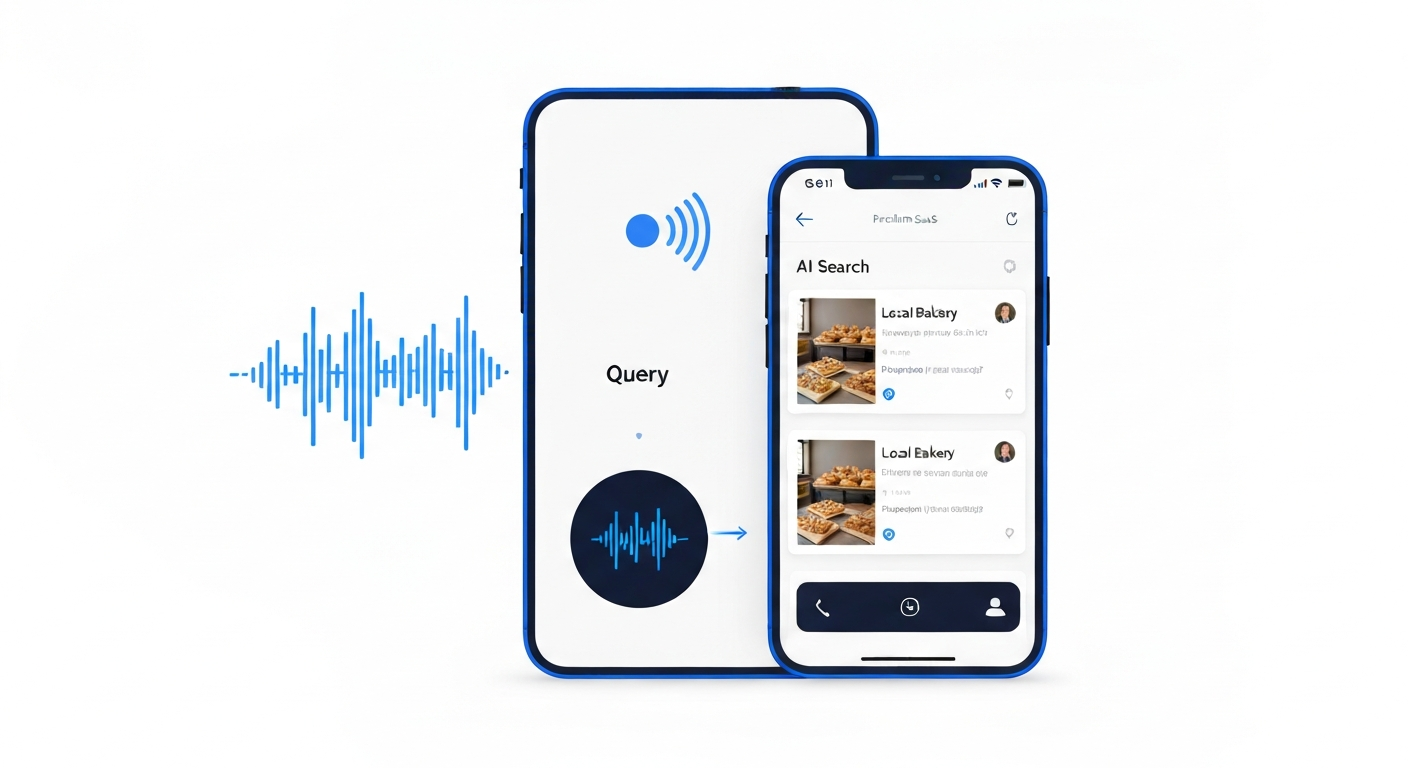
Picture this: A homeowner discovers a burst pipe at 6:00 AM. They don't sit down at a desktop computer to type out a careful search. They grab their phone and yell, "Hey Siri, who's the best emergency plumber near me open right now?" If you haven't mastered voice search optimization for local businesses, you are entirely invisible to that search.
The same goes for AI. People are increasingly asking ChatGPT or Google's AI Overviews to "recommend a highly-rated local dentist who takes Delta Dental." Voice and AI search are no longer the future—they are the present. If your business isn't optimized for conversational, "near me" discovery, you are handing high-intent customers directly to your competitors. Let's fix that.
Table of Contents
- The Rise of Voice Search & AI-Powered Discovery
- Why Most Local Businesses Are Invisible to Voice Search
- How to Optimize Your Business for Voice & AI Search — Step by Step
- How to Get Your Business Recommended by ChatGPT and AI Tools
- Voice Search Optimization Checklist for Local Businesses
- Frequently Asked Questions
The Rise of Voice Search & AI-Powered Discovery
Voice search and AI-driven discovery have fundamentally changed how local customers find services. They no longer search for keywords; they ask complex, conversational questions expecting immediate, accurate answers.
How Customers Are Actually Searching for Local Businesses in 2026
Over 50% of consumers now use voice search daily to find local business information. Whether they are driving, cooking, or simply multitasking, speaking is faster than typing. AI search engines like ChatGPT and Google AI Overviews are replacing traditional search results by synthesizing data into direct recommendations.
Voice Search vs. Typed Search — Why They're Completely Different
Typed searches are short and robotic. Voice searches are long, conversational, and hyper-specific. If your website only targets robotic keywords, voice assistants won't know how to read it.
| Typed Search Query (Old SEO) | Voice / AI Search Query (New SEO) |
|---|---|
| "plumber austin tx" | "Hey Siri, find the best emergency plumber near me that is open right now." |
| "best hair salon downtown" | "Alexa, what's a highly-rated hair salon downtown that specializes in balayage?" |
| "HVAC repair cost" | "ChatGPT, how much does AC repair typically cost in my area, and who do you recommend?" |
Why Most Local Businesses Are Invisible to Voice Search
Being invisible to voice search usually comes down to missing data. Voice assistants rely on structured, easily accessible information to give users a single, definitive answer.
The 5 Most Common Voice Search Optimization Mistakes
Most businesses fail because they have incomplete directory profiles, slow-loading websites, inconsistent address formats, zero FAQ content, or a lack of recent reviews. If a voice assistant isn't 100% confident in your business hours or location, it will recommend a competitor instead.
Why Being #1 on Google Doesn't Guarantee a Voice Search Result
Google Search and voice assistants pull from different databases. Siri relies heavily on Apple Maps and Yelp. Alexa uses Bing Places and Yext. You can be #1 on Google, but if your Yelp profile is empty or your Apple Maps listing is wrong, Siri won't know you exist.
How to Optimize Your Business for Voice & AI Search — Step by Step
Optimizing for voice and AI requires a shift from keyword stuffing to providing clear, authoritative answers. Here is how to make your business the definitive answer in your local area.
Step 1 — Claim and Perfect Your Google Business Profile
Your Google Business Profile is the primary data source for Google Assistant and Google AI Overviews. Ensure every field is filled out accurately, including special hours and specific service categories. For a deep dive, read our guide on Maximizing Your Google Business Profile.
Step 2 — Add Conversational, Question-Based Content to Your Website
Stop writing like a robot. Write your website copy exactly how your customers speak. Use natural language, address common pain points directly, and answer the specific questions they ask over the phone.
Step 3 — Build a Comprehensive FAQ Page
Voice assistants love FAQ pages because they are formatted as Question-and-Answer—exactly how voice search works. Create a dedicated FAQ page that answers questions about pricing, service areas, warranties, and turnaround times.
Step 4 — Optimize for "Near Me" and Location-Based Queries
Voice searches are highly localized. Ensure your website clearly states your city, neighborhood, and surrounding service areas in the footer, contact page, and service pages. Embed a Google Map on your contact page to reinforce your location data.
Step 5 — Earn Reviews (Voice Assistants Prioritize Highly-Rated Businesses)
When someone asks for the "best" plumber, voice assistants filter out businesses with low ratings or low review counts. You must actively collect reviews. Learn How to Get More Google Reviews Without Asking Every Customer Manually to build this authority on autopilot.
Step 6 — Ensure NAP Consistency Across All Directories
NAP stands for Name, Address, and Phone number. If your business is listed as "Main St." on Google but "Main Street" on Yelp, voice assistants get confused and drop your ranking. Keep your NAP 100% identical across every single directory on the internet.
How to Get Your Business Recommended by ChatGPT and AI Tools
AI search engines like ChatGPT don't use traditional SEO algorithms. They synthesize data from across the web to formulate a confident recommendation.
What AI Search Engines Look For When Recommending Local Businesses
AI looks for consensus. It scans review sites, local news articles, forums, and directories to see if a business is consistently mentioned as reputable. It also looks for deep, informative content on your website that proves your expertise.
How to Build the Online Authority AI Trusts
To get recommended by AI, you must practice Local SEO Beyond Keywords. This means getting mentioned on other local websites, participating in community events, and having a wealth of positive, detailed customer reviews that mention specific services.
The Role of Reviews, Citations, and Content in AI Recommendations
AI engines summarize reviews. If dozens of reviews say, "They arrived on time and fixed my AC fast," ChatGPT will confidently tell users, "This company is known for fast, punctual AC repair." Your reviews are literally training the AI on what to say about you.
Voice Search Optimization Checklist for Local Businesses
Use this scannable checklist to ensure your business is ready for the voice and AI search revolution:
- ✓ Claim and verify your Google Business Profile.
- ✓ Claim your Apple Maps and Yelp listings (crucial for Siri).
- ✓ Claim your Bing Places listing (crucial for Alexa).
- ✓ Audit your NAP (Name, Address, Phone) for 100% consistency across the web.
- ✓ Add an FAQ page to your website with conversational questions and direct answers.
- ✓ Ensure your website loads in under 3 seconds on mobile devices.
- ✓ Use Schema Markup (LocalBusiness JSON-LD) on your website.
- ✓ Include specific neighborhoods and "near me" language in your site copy.
- ✓ Implement an automated system to consistently generate 5-star Google reviews.
- ✓ Respond to all reviews (positive and negative) using natural, descriptive language.
- ✓ Write blog content that answers specific, long-tail customer questions.
- ✓ Ensure your business hours are accurate everywhere, especially for holidays.
Frequently Asked Questions
What is the difference between voice search and regular SEO?
Regular SEO targets short, typed keywords (like 'plumber Austin'). Voice search SEO targets conversational, long-tail questions (like 'Who is the best plumber near me open right now?'). Voice search also relies heavily on local directories and Google Business Profile data.
How do I get my business to show up on Siri or Alexa?
Siri pulls data primarily from Apple Maps and Yelp, while Alexa pulls from Bing Places and Yext. To show up on both, you must ensure your Name, Address, and Phone number (NAP) are consistent across all these major directories.
Does ChatGPT recommend local businesses?
Yes. ChatGPT and other AI search tools recommend local businesses by scanning the web for highly-rated companies with strong, consistent reviews, authoritative local content, and prominent directory listings.
Why is my business not showing up in "near me" searches?
You likely have an incomplete Google Business Profile, lack recent 5-star reviews, or your website doesn't explicitly mention your city, neighborhood, and the specific services you offer in a conversational tone.
How long does it take to optimize for voice search?
You can implement the basics—like updating your Google Business Profile and adding an FAQ page—in a few hours. However, building the review velocity and local authority needed to rank consistently takes 3 to 6 months of ongoing effort.
Written by the CastaLink Team — helping local businesses stay visible in an AI-driven world. For a complete strategy, read Your Local Business's Complete Marketing Playbook.
The CastaLink Team
Growth Experts
We help local service businesses stop chasing leads and start building automated growth machines. Our team shares weekly insights on marketing automation, local SEO, and operational efficiency.
Read More Articles

How to Stop Losing Leads After Hours
Discover how AI booking assistants can capture and convert leads while you sleep.

The 5-Minute Follow-Up Rule is Dead
Why instant text-backs are replacing the traditional 5-minute follow-up rule in local service businesses.
